Purpose-built GUIs for embedded Linux – robust, intuitive, and ready for the real world
We develop embedded user interfaces that go beyond clean visuals: tailored to your hardware, designed for long-term maintainability, and ready for deployment in complex environments.
Embedded GUI development is more than just design – it’s about technical depth and tailored integration.
Building user interfaces for embedded systems means balancing tight hardware limits, diverse platforms, and rising expectations for intuitive UX. Time-to-market pressure adds another layer of complexity.
At Antunes, we bring together deep technical expertise in embedded Linux, low-level integration, and middleware architecture – with a practical mindset for UI/UX. The result: graphical interfaces that are fast, stable, and seamlessly integrated into your system environment.
Interfaces built around your hardware
We design GUIs that match your hardware architecture and screen characteristics – scalable, responsive, and ready for deployment.
Optimized for embedded constraints
We engineer interfaces that run smoothly under limited CPU, memory, and power – without compromising on user experience or reliability.
UX that simplifies complexity
We bridge the gap between IoT logic and human interaction: intuitive interfaces, clean UI flow, and seamless backend integration.
Beyond Interfaces: Embedded GUIs Engineered for Strategic Advantage
Our services go far beyond just building interfaces. We design embedded GUI systems that are technically sophisticated, highly performant, and purpose-built to give your product a lasting edge – even under tight hardware constraints.
Smart GUI Frameworks for Embedded Linux
We don’t follow industry defaults. We challenge them – using modern Microsoft-based frameworks to build future-proof, cross-platform GUI systems for embedded Linux.
Instead of conventional embedded frameworks, we use .NET 8/9 with Uno Platform and MAUI to create highly maintainable and scalable GUI applications.
Unified codebase across Linux, Web, Mobile and Desktop
Native speed and modern UI flexibility
Seamless integration with your .NET infrastructure
Shorter time-to-market with modern toolchains
Uno enables WebAssembly, Skia and native Linux UI layers, ideal for demanding GUI scenarios. MAUI adds mobile and hybrid hardware flexibility.
Result: Long-living, high-performance GUI systems – without vendor lock-in.
Designed for Efficiency – Not Just Functionality
Our GUIs are engineered for performance from day one. That means fast rendering, minimal resource use, and zero compromises on stability – even on single-core, low-RAM devices.
Practice Case: GUI Development in Demanding Embedded Environments
Whether in aviation, industrial control or smart city applications – our GUI solutions are developed in the challenging intersection between demanding usability requirements and harsh system conditions. We rely on modern frameworks like .NET MAUI and UNO Platform running on Embedded Linux to deliver cross-platform, high-performance, and long-lasting interfaces.
Proven in Harsh Conditions: Certified GUI for Aviation
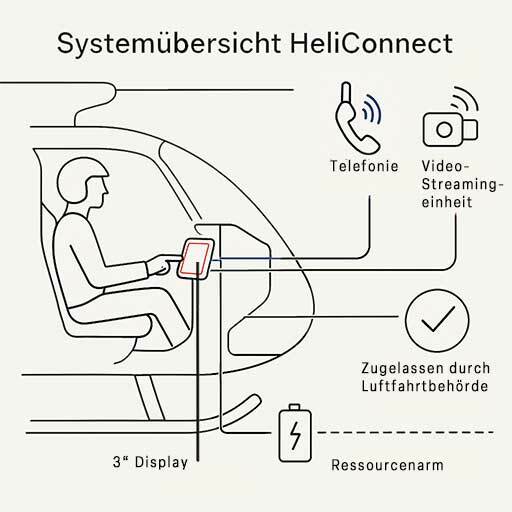
One of our most demanding projects involved developing a cockpit UI for a helicopter system – running on a 3-inch screen, with limited memory, and no standard network connectivity. Communication had to work via a custom, certified protocol, and the device needed to operate for several hours on battery power – under full load. Despite these constraints, we delivered a fully aviation-certified, highly intuitive interface.
Compact. Energy-efficient. Certified.
Modular and Scalable: GUI Middleware for Industrial Device Management
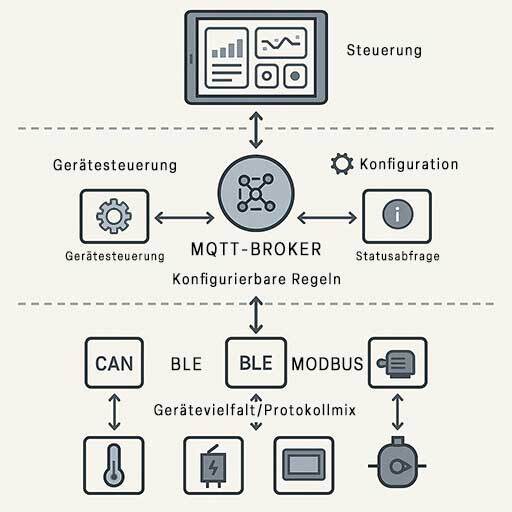
In an ongoing large-scale project, we developed a scalable middleware UI for managing and controlling a diverse range of field devices – from sensors to actuators, using various industrial protocols. Originally built with .NET Core, the system was migrated to Embedded Linux for enhanced flexibility, better integration, and future-proof scalability. The interface is optimized for clarity, responsiveness, and real-time performance, even under high system load and active data traffic.
Flexible. Real-time capable. Extendable.
Mobile and Intuitive: Smart GUI for Sensor-Based Applications
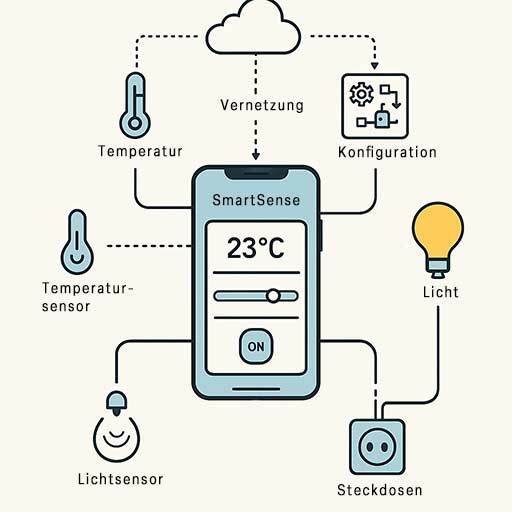
For mobile use cases like SmartSense, our focus was on seamless UX and real-time feedback. The result: a touch-based app that automatically detects compatible devices, displays sensor data (e.g. temperature, light, humidity) in real time, and allows for custom automation workflows. Energy-efficient background communication (via Bluetooth or WiFi) ensures smooth operation – even across changing environments.
Intuitive. Mobile. Context-aware.
GUI Reference Use Cases (Anonymized)
HeliConnect
Certified GUI for secure airborne communication
Custom touchscreen interface for helicopter cockpits. Enables telephony and video system control on a 3" display – with flight approval and without classic network dependencies.
Compact. Energy-efficient. Certified.
Device Hub
Scalable middleware GUI for managing connected devices
Modular interface to configure and control heterogeneous field devices using MQTT and other protocols – designed for long-term maintainability in complex industrial environments.
Flexible. Real-time capable. Extendable.
SmartSense
Mobile UI for Smart Home and City devices
App interface for Bluetooth- and WiFi-based sensors – detects compatible hardware, enables custom automations and displays live metrics in a touch-optimized, minimal UX.
Creating effective embedded GUIs takes more than just good design – it requires engineering precision, industry insight, and a deep understanding of the user context.
At Antunes IT Services, we combine all three: from architectural design to seamless deployment on real hardware. Whether it's a touchscreen cockpit interface, a scalable device control system, or a mobile UI for sensor-based applications – our solutions are not just front ends, but reliable, deeply integrated systems built for the real world.
Meet the team that brings this quality to life – with years of experience, a clear technical mindset, and true passion for embedded innovation.
Edgar Antunes
Founder & CEO
Founder and CEO of E. Antunes Software – and a strategic mind at the intersection of embedded systems and scalable software. With deep technical expertise and a future-oriented mindset, Edgar develops solutions that perform reliably in industrial environments, cockpits, and smart devices.
Drives architecture decisions, interface design, and long-term technology strategies that ensure systems are built to last.
Every project begins with a targeted analysis of your users’ needs and context. We conduct user interviews, build interactive prototypes, and run usability tests early in the process. This ensures we design interfaces that feel intuitive from the start – not ones that need to be explained.
Yes. We develop cross-platform solutions using frameworks like .NET MAUI, Blazor, and Uno Platform. From the start, we take into account different hardware profiles, screen sizes, and performance classes. We also test on real target devices to ensure a consistent user experience across the board.
We use a modern .NET stack that integrates front end, middleware, and backend in one ecosystem. This reduces friction and speeds up development. Thanks to C# and XAML, we can cover a lot from a single codebase – which positively impacts maintainability, scalability, and overall budget. For UI design, we use Figma; for development, Visual Studio – both fully integrated into our workflow.
From day one, we analyze your existing systems – including APIs, data flows, and expected load. We integrate the GUI via clean APIs and robust protocols, always with performance in mind. We optimize with caching strategies, lazy loading, and real-world load testing. If necessary, we fine-tune at the protocol level to ensure stability even under heavy load.
We define KPIs with you early on, such as user adoption rate, interaction times, or error frequency. Before going live, we conduct User Acceptance Tests (UAT) with actual users. After the rollout, we continue to support you with usage monitoring, feedback loops, and practical improvement recommendations based on real-world usage.
Cookie-Settings
We use cookies to provide you with an optimal website experience, personalize content, and analyze usage. By giving your consent, you help us improve our services. You can adjust your cookie settings at any time. For more information, please see our Privacy Policy.
Details of the third-party we use
Category
Service
Purposek
Essential
Google Tag Manager
Management of website tags+
Provider: Google Ireland Limited Cookies: No own cookies Data collected: None – the service itself does not process personal data. However, data may be collected by embedded services. Legal basis: Art. 6 (1) (f) GDPR (legitimate interest in managing website tags) Privacy:Google Tag Manager Use Policy
Analytics
Google Analytics
Statistical analysis of website usage (anonymized).+
Provider: Google LLC Cookies:
_ga – Stores an anonymous ID to recognize returning visitors (2 years)
_gid – Stores an anonymous ID for the session (24 hours)
_gat – Used to throttle the request rate (1 minute)
Data collected: IP address (anonymized), usage behavior, page views, click behavior, browser and device characteristics Legal basis: Art. 6 (1) (a) GDPR (consent) Privacy:Google Privacy Policy
Analytics
Microsoft Clarity
Analysis of user behavior (heatmaps, scroll and click behavior).+
Provider: Microsoft Corporation Cookies:
_clck – Stores user ID to recognize returning visitors (1 year)
_clsk – Connects multiple page views within a session (1 day)
Data collected: Scroll activity, mouse movements, clicks, time spent on the page, screen size, IP address (anonymized), device type Legal basis: Art. 6 (1) (a) GDPR (consent) Privacy:Microsoft Privacy Statement
Marketing
Google Ads
Placement and evaluation of ads in Google Search or on partner websites.+
Provider: Google Ireland Limited Cookies:
IDE – Used to display personalized advertising (13 months)
ANID – Used for advertising outside the provider’s own domain (13 months)
Data collected: Interaction with ads, pseudonymous user ID, IP address, browser information Legal basis: Art. 6 (1) (a) GDPR (consent) Privacy:Google Ads Privacy Policy
Personalization
Google Ads – Ad Personalization
Delivery of personalized ads based on user behavior and interests.+
Provider: Google Ireland Limited Cookies:
NID, ANID, SID – Store user preferences and personalize ads (various lifetimes)
Data collected: Search history, interaction with ads, browsing behavior, device and browser information, IP address Legal basis: Art. 6 (1) (a) GDPR (consent) Privacy:Google Ads Policies
Personalization
Google Consent Mode
Processes the consent status for Google services without performing any tracking itself.+
Provider: Google Ireland Limited Cookies:
personalization_storage – Technical cookie for managing consent (6 months)
Data collected: No user-related data – solely used to transmit the consent status to Google APIs Legal basis: Art. 6 (1) (a) GDPR (consent) Privacy:Consent Mode Documentation